Blue Revolution Hawaii (BRH) organized a session at the Aquaculture America 2018 in Las Vegas. Board member Benny Ron has been very active with NOAA and international partners advancing the field. Representing Blue Revolution Hawaii, Benny and BRH founder, Pat Takahashi, made a presentation on the
Pacific International Ocean Station.

Usually, on all campuses world-wide, there is a solid core of ocean scientists who make its mark measuring, modeling and repeating the process with better equipment over time. Now and then there might be a couple of ocean engineers, half helping those scientists with the technology of measurement, and the other half attempting to create a career to apply ocean science knowledge, linking with industry to do something useful for the economy and world. There is almost no federal funding in this esoteric area.

In essence, the Blue Revolution is that esoteric field. Some of us have long
(third of a century??) been touting the Blue Revolution as something ideal for the future of our society, for, while producing sustainable products and clean energy, the concept shows promise for reducing the incidence of hurricanes and remediating global warming. As ultimate profit will be the motivation, this could well be the most convincing reason why the system can be the ideal solution for ameliorating climate change. All other geoengineering options merely cost a lot of money, with some provoking
serious concern for the environment itself.


If Hitler succeeded before the Allies, who knows what the world would be today. The success of the Apollo Project has been said to be primary reason why the USA prevailed over the Soviet Union around 1990, bringing an end to the Cold War and the fear of a nuclear winter. Sure, we still have a mettlesome North Korea, a pugnaciously commercial China and a noisy Russia, but the
Doomsday Clock remains precariously set at 2 minutes to Midnight, mostly because of global climate change.

So what is the next greatest challenge for Humanity and Planet Earth? Overcoming Hitler helped develop nuclear power, with the potential for more bombs, leading to Chernobyl and Fukushima, with a continuing rocky future. The Apollo Project showed that there was no really attractive commercial case for the Moon, and less for Mars. Next, marshaling of international cooperation towards reduction of carbon dioxide combustion, while actually enhancing long-term human productivity?
If Global Warming is this next challenge, there is one compelling reason why the Blue Revolution can be the next great solution for Planet Earth and Humanity: PROFIT. Just
absorbing carbon dioxide makes no sense because it is too expensive a process. Clean coal technology similarly is a money-loser. There is no way to make a profit from just removing carbon dioxide from the atmosphere. We can, of course, stop using fossil fuels, but that will take time. Ocean thermal energy conversion, or
OTEC, is one these options

That is the advantage of the
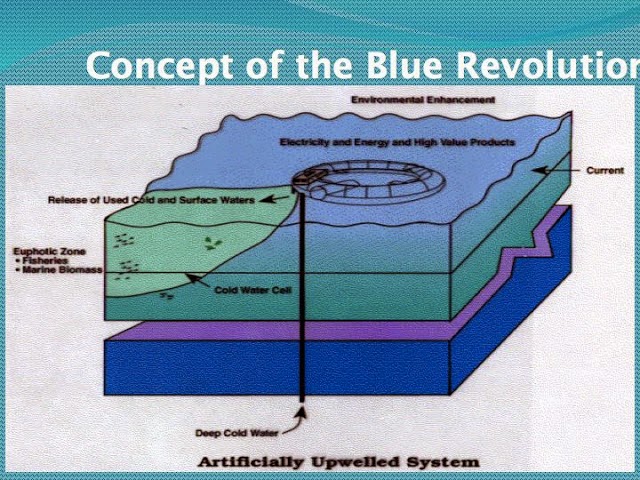
Blue Revolution, for the whole process will be powered by sustainable OTEC, a technology that begins to become competitive only at 1000 MW sizes and larger. The total system uses the heat of the ocean, which is replenished by the sun, with the cold portion coming from Arctic and Antarctic regions. In addition to electricity and freshwater, there will be a cornucopia of sustainable products, such as next generation fisheries, marine biomass plantations, hydrogen, biomethanol, comfortable new habitats, exciting marine tourism enterprises and much more. These Blue Revolution platforms will in time become floating cities and industrial parks. Most of them will be positioned along the equator, where the temperature difference is the greatest, and where hurricanes don't come. However, platforms could also be placed in hurricane formation zones, with a goal to drop the ocean surface temperature by a degree or two to eliminate the formation of these ocean storms. Thus, in time, much of the ocean between the 20th parallels can be utilized for these purposes:


Let us say, then, that ocean cities and Disneys-at-Sea someday become prominent, how exactly will global warming be remediated? The chemical balance between the sea and atmosphere, affected by the blue revolution process, possibly needing the addition of iron, should result in the absorption of carbon dioxide, converting this gas into solid compounds, which will drop to the bottom of the ocean, and stay there for a very long time.
The French invented OTEC (to the right, Jacques-Arsene d'Arsonval). Here are two French sources providing intriguing insights:
For decades, our study teams hinted that a sum of $1.5 billion was necessary to kick-start the Blue Revolution. However, all this will get you is a floating platform, possibly powered by a 10MW OTEC facility, supporting an array of pre-commercial experiments to develop sustainable co-products. At least, at this cost, perhaps an enterprising billionaire seeking a legacy could be found to lead the effort.

The reality, though, is that something closer to $150 billion will be required to support a full city/industrial park with a 1000 MW OTEC plant. If the first system makes money, more will be built. After all, the
Navy has proposed a Columbia-class nuclear submarine force estimated to have a lifecycle cost of $347 billion.
Does this change the dynamics of funding, for even Jeff Bezos only has
$158 billion? Not really, for all this will take time, and Bezos could well someday attain
trillionaire status. Here are
six others also said to be primed to reach that level. The leadership of this trillionaire, or team of them, will determine the optimal pathway for the
Ultimate Blue Revolution.
Back to our Defense budget, no question that this sought-after $347 billion expense will improve our national fighting-ship. But why, for we today have no mortal enemy poised to attack us. The USA always annually spends more for war than the next seven or eight nations put together, mostly because of the effectiveness of the Military Industrial Complex. Well,
Bernie Sanders says the we spend more money on defense than the next 12 countries combined. Perhaps Bernie has special info, for the estimated U.S. military spending from 1 October 2019 to 20 September 2020 shows our country allocating more on defense than the
next NINE countries, combined.
For the record, here are some 2018 graphics showing the last official comparison:
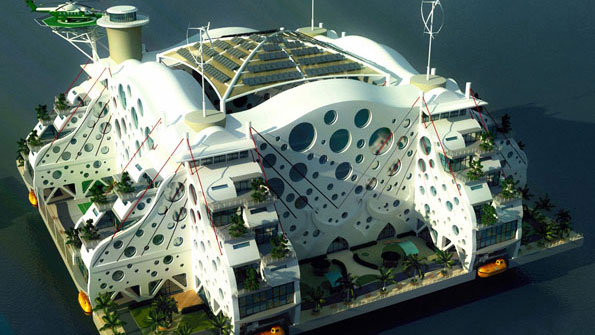
Thus, that first $150 billion Blue Revolution platform (
to the right something from the Seasteading Institute) will just be step one towards solving our looming global warming problem. If each can turn a healthy profit, more, quickly, could reverse climate change.
Remember how expensive the Manhattan and Apollo Projects were?
Well:

So, you ask, where can anyone find $150 billion to build the first operational floating city? Start with shifting spending from war to Earth peace, and get help from future trillionaires.
-